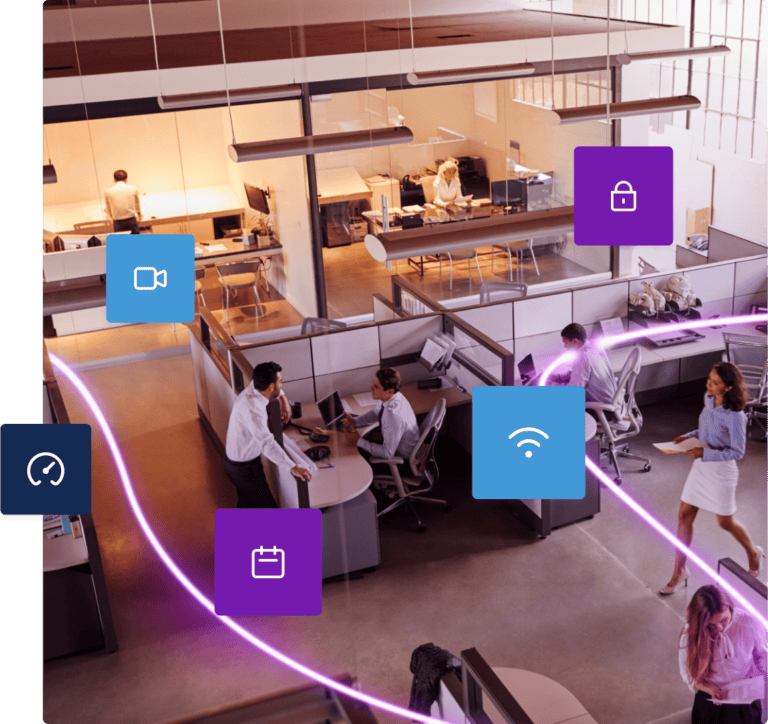
The best digital experiences are invisible. They just work, without friction.
Walk into a flexible workspace and you can tell instantly if the digital experience (DX) is right – precisely because you don’t notice it. Your phone roams onto the network in seconds. Your laptop remembers your credentials across locations. Doors open when and where they should. The meeting room you booked is ready, the screen connects, guests join, and you’re into the work – not the workflow. That “nothing to see here” moment is the product of invisible systems that underpin everything tenants value and operators rely on: satisfaction, operational efficiency, and revenue.
Today, invisibility isn’t a nice-to-have – it’s table stakes. Hybrid work is now embedded across organisations (CBRE puts hybrid adoption at 92%), which means more movement between locations, more ad hoc collaboration, and a higher bar for consistency across a portfolio. If the experience wobbles in one building, it erodes confidence in the brand across all of them.
What tenants silently expect (and judge you on).
Occupiers may tour the coffee bar and admire the fit-out, but they sign and renew on the everyday basics. In recent research of business leaders in the US and UK, good internet/Wi-Fi connectivity topped the list of what tenants look for when choosing a building (62%), followed by excellent mobile/5G reception (54%). In other words, connectivity now outranks many visible amenities when it comes to lease decisions.
Inside the space, friction-free access and bookings are a quiet hallmark of quality. CBRE reports 88% of organisations now use space reservation systems; most use them to book meeting rooms (85%) and an increasing share to book workstations (62%). That’s a clear signal that tenants expect digital orchestration of their day-to-day use of space – and they notice when it fails.
Finally, the flex promise isn’t a single-address promise. For multi-site operators, members expect the same credentials, the same experience, and the same reliability everywhere they go. Invisible systems make that consistency feel effortless.

Invisible systems, visible outcomes.
Here’s how behind-the-scenes DX translates directly into the metrics leadership cares about.
Tenant satisfaction & retention.
When connectivity, access, and bookings “just work,” support tickets fall and sentiment rises. That’s pivotal in a market where occupiers are gravitating to quality and experience. JLL’s latest global benchmarks show office utilisation has improved to ~54%, yet still trails the average target of ~79% – meaning operators need experiences compelling enough to close the gap without heavy-handed mandates. The operators that deliver invisible, reliable DX are best placed to make the office a destination, not an obligation.
Revenue capture.
Meeting rooms are a major lever. Two patterns hurt revenue: (1) rooms booked but unused (no-shows or “ghost meetings”); and (2) ad hoc demand you can’t capture because access and AV setup introduce friction. Industry guidance suggests 40–60% room utilisation is a reasonable benchmark; anything lower is a red flag for leakage or mismatch between supply and demand. Operators that pair real-time booking with seamless access and plug-and-play connectivity consistently convert more “spur of the moment” meetings into paid usage – without friction.
Operational efficiency.
The less your team has to touch, the more scalable your model is. Think zero-touch network provisioning, automated access control tied to booking state, and remote insight into utilisation. CBRE also notes the rising maturity of space and reservation management across portfolios, signalling that digital tooling for operations is now mainstream – not experimental.
Pricing power.
Demand for flexible solutions keeps building. Cushman & Wakefield’s 2025 review found 55% of global occupiers use flexible offices, with meeting room bookings up double-digits across regions (APAC +24.5%, Americas +22.0%, EMEA +17.4%). If collaboration is rising, the premium will accrue to operators who make it effortless – because “effortless” is what corporate teams will pay to protect.

The economics of invisibility (data-led).
Let’s connect a few market datapoints to P&L outcomes:
Quality beats quantity.
JLL’s Occupancy Planning Benchmark shows organisations are shifting from blunt cost-cutting to portfolio optimisation, with higher utilisation targets and a renewed focus on experience. Translation for operators: there’s budget for better space – if you can prove it delivers measurable productivity and collaboration outcomes.
Connectivity is a lease driver.
With 62% of decision-makers prioritising fast, reliable Wi-Fi and 54% prioritising strong mobile/5G reception, anything short of “always on” and “building-wide” (even “portfolio-wide”) becomes a blocker to sales and renewals. Invisible connectivity is now part of your go-to-market.
Bookings are now operator infrastructure.
With most organisations expecting portfolio-wide reservation capability, it’s on flex operators to provide seamless, centrally managed booking for shared amenities – meeting rooms, desks, phone booths, studios, parking and more. The customer journey runs from your booking UI to the door reader and into the room AV. If that chain breaks anywhere, utilisation drops and revenue leaks.
Collaboration demand is rising.
The upswing in meeting room bookings reported by Cushman & Wakefield across all regions is a signal that smart, zero-friction room journeys are a revenue engine, not an IT project. Digital experience drives competitive advantage.
Why invisibility is hard (but worth it).
Delivering “nothing to see here” is technically and organisationally demanding:
-
Multi-tenant complexity. Your user base changes daily. Guests need controlled access, members need persistence across locations, and enterprises need role-based entitlements. Networks and access systems must adapt in real time.
-
Portfolio consistency. No two buildings are the same, yet the experience must be. That requires abstracting building idiosyncrasies behind a common, cloud-managed control plane—so the member journey is identical in London and Los Angeles.
-
Integration debt. Point solutions that don’t talk to each other create seams your members feel: duplicate logins, lag between booking and access, AV handshakes that make people late. Invisibility only happens when platforms integrate bookings, identity, access, and network policy.
-
Data without friction. Leadership wants to know what’s being used, by whom, and when. The least intrusive, most reliable signals often come from the network and access layers you already operate—if they’re instrumented correctly.
The prize for getting this right is meaningful: lower support overhead, higher NPS, and a measurable lift in retention and ancillary revenue.
How to go from “good enough” to invisible: 5 moves leaders can make now.
-
Standardise the Wi-Fi experience across your portfolio.
One identity, one policy, many locations. Design for fast, secure, roaming-grade onboarding. Measure digital experience (latency, stability, failed logins), not just uptime. The goal is that a tenant never asks for the Wi-Fi password or complains that they can’t connect – wherever they are across your portfolio.
-
Tighten the calendar-to-door journey.
Bind meeting room bookings to access control in real time. When the meeting starts, the room is available and unlocks for the right people; when it ends, it resets. Use mobile wallet access credentials (like Apple Wallet) to make the journey as easy-to-use as possible. This reduces squatting and ghost meetings and helps push room utilisation toward that 40–60% benchmark.
-
Instrument the space using systems you already own.
Before you invest in new sensors, mine the signals you have – WiFi data and telemetry is a goldmine for understanding true utilisation, for example. Combine that with insights from space reservations and room bookings, and used together, they give you a powerful, privacy-preserving utilisation picture that leadership can trust.
-
Design “fast paths” for guests.
Make guest Wi-Fi access secure but simple with time-boxed captive portal credentials. Allow visitors to book and access your meeting rooms by tying external bookings to internal access control.
-
Consolidate where fragmentation causes friction.
Fewer panes of glass for site teams; more automation from the centre. The more you orchestrate from the platform layer, the less variability creeps into day-to-day operations.
If you’re pursuing an invisible, portfolio-wide digital experience, essensys builds technology purpose-built for flexible workspaces: connectivity that feels effortless to members, access that follows intent, and data that helps leaders see what’s working – without adding friction.